EKR Redesign (DÁP)
Rethinking a Complex Government System
Role
UX Designer · UX Researcher
Duration
cca. 1,5 years
Domain
e-Government · Enterprise UX
Focus Areas
Supplier workflows· information architecture · UX research
Overview
The Electronic Public Procurement System (EKR) is a long-established government platform that supports the end-to-end procurement processes of both contracting authorities and suppliers. The goal of the project was to improve system usability, simplify navigation, and reduce user uncertainty. The redesign was built on the foundations of the DÁP Design System.
Problem
Research revealed that the system’s biggest challenges stemmed not from its visual appearance, but from its complex workflows and information architecture.
Key Challenges
Difficult to learn and navigate
Fragmented navigation structure
Multiple parallel search interfaces
Inconsistent UI patterns
Insufficient system feedback
High cognitive load
Users tended to think in terms of tasks and processes, while the system itself was organized around modules and functionalities. This mismatch created confusion and inefficiencies throughout the user journey.
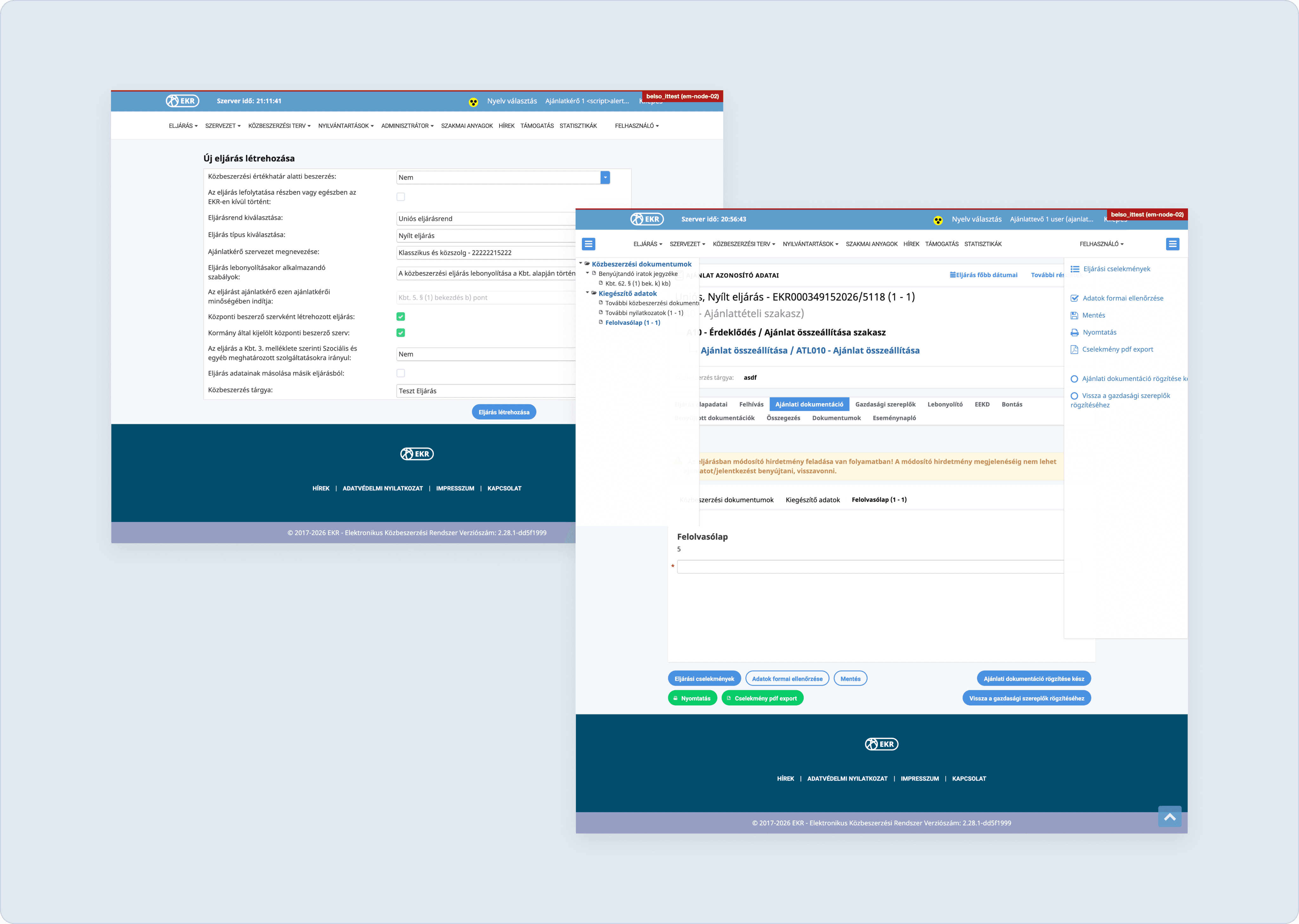
On current screens, the interface is overcrowded and navigation is problematic.
Research & Insights
Research Methods
Stakeholder interviews
User interviews
Heuristic evaluation
Card sorting workshops
User journey analysis
Competitor analysis

Card sorting results
My Contribution
Conducting user interviews
Facilitating card sorting workshops
Information architecture research
Synthesizing research insights
UX design of supplier-facing workflows
Key Insights
Navigation Was the Biggest Pain Point
Users frequently got lost within the menu structure and struggled to locate the functions they needed.
The System Created Too Much Uncertainty
Critical workflows often lacked status indicators and meaningful feedback, leaving users unsure whether their actions had been completed successfully.
Many Problems Were Not UI Problems
A significant portion of the usability issues originated from outdated workflows and poorly structured processes rather than visual design shortcomings.
Design
Information Architecture Redesign
Based on the results of the card sorting workshops, we developed a new menu structure and sitemap.
Goals:
Simpler navigation
More logical grouping of content
Reduced redundancy
Process-oriented structure


Existing IA and the new IA
Redesign of Core Workflows
I was responsible for the UX design of supplier-related processes.
Key workflows included:
Bid preparation
Bid submission
Document management
Procedure tracking


Existing user flow and the new user flow
Dashboard Concept
Research findings led us to adopt a dashboard-first approach.
Goals:
Faster overview of key information
Better visibility of critical tasks
More task-oriented user experience

Final dashboard UI
Design System Integration
The redesign was built using the DÁP Design System.
Focus areas:
Unified component library
Consistent calls-to-action
Improved accessibility
Clearer visual hierarchy
Solution
The final concept resulted in a more workflow-oriented, easier-to-learn, and more modern system.
Key Improvements
New navigation system
Unified component library
Dashboard-based homepage
Improved status communication
More transparent workflows
More accessible user interface


Before and After form UI
Results
Deliverables
Identification of 100+ UX issues
New information architecture
Redesigned navigation system
Interactive Figma prototypes
Dashboard concept
Workflow-based UX guidelines
Dashboard concept and Contracting Authority flow
Workflow-based UX guidelines and Bidder flow
Learnings
This project reinforced my belief that UX in complex enterprise systems is not about making interfaces look better - it is about solving real operational problems.
The most valuable lesson for me was that reducing user uncertainty often creates more value than a visually impressive redesign. Many of the issues uncovered during research originated from workflow and system-logic problems, which meant that the solutions also had to be addressed at that level.
